


Why open compressed air blow-off is dangerous for personnel and which technologies enable safe dust removal at industrial enterprises.
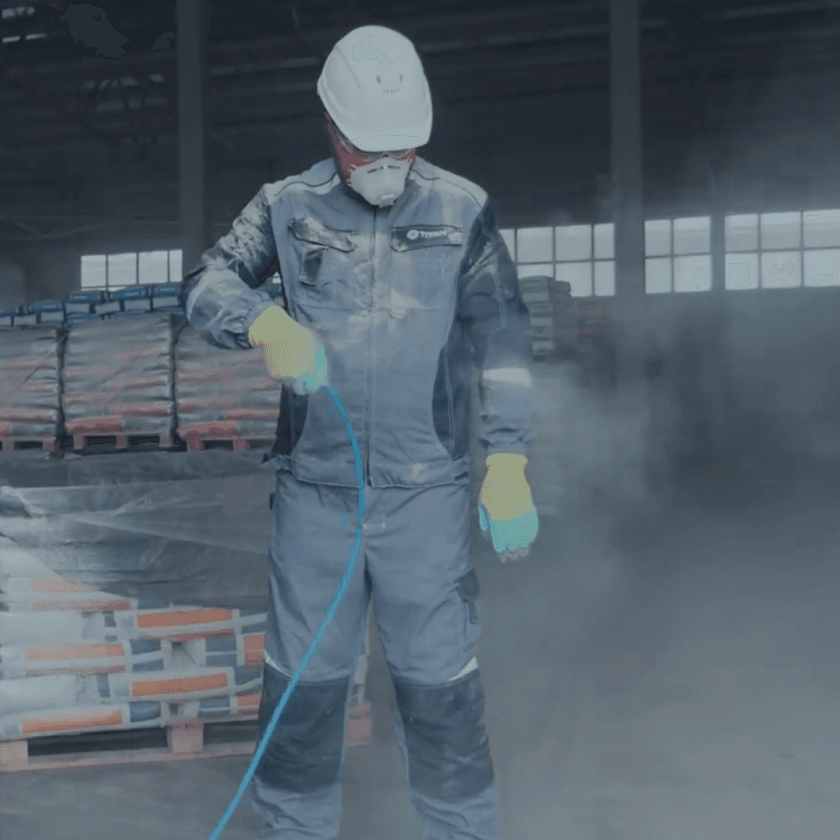
At enterprises with high dust levels, workers’ workwear is often cleaned with compressed air. A directed jet quickly blows visible dirt off the fabric and gives the impression of effective cleaning.
But open blow-off without organized dust collection has two fundamental problems: the risk of injury and the uncontrolled spread of industrial dust. That is why, when choosing a cleaning method, it is important to assess not only speed but also the safety of the procedure itself, and where the removed dust ultimately ends up.
Compressed air hazards to people
Compressed air carries considerable energy. As it leaves the nozzle, it forms a directed jet whose force depends on the pressure, the nozzle design and the distance to the surface. When such a stream is aimed at a person, the risks cannot be judged only by how strong the jet seems.
-
Damage to skin and soft tissue
The jet can injure the skin, especially when the nozzle is held close. Through wounds, air can penetrate soft tissue.
In rare but especially dangerous cases, air enters the bloodstream and causes an air embolism — air bubbles disrupt blood circulation.
-
Eye injuries
The jet stirs up dust and fine solid particles. When they get into the eyes, they cause irritation and mechanical damage — metal shavings and mineral grit are especially hazardous.
-
Effects on hearing
Working with pneumatic equipment involves intense noise. A jet near the ears further increases the risk of hearing damage, especially without hearing protection.
-
Dust entering the respiratory system
Particles removed from clothing form a dust cloud in the breathing zone of the worker and those nearby. Fine dust penetrates deep into the respiratory system.
-
Secondary workplace hazards
Airborne dust creates additional hazards. A cloud of certain types of combustible dust can become a fire and explosion hazard if an ignition source is present.
Why open blow-off does not solve the dust problem
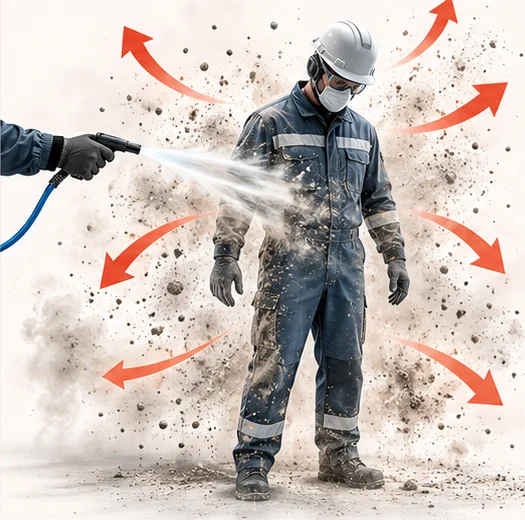
Removing dust from clothing does not mean removing it from the work environment. Without a collection system, particles become airborne, are carried by air currents and settle on surrounding surfaces.
-
01
Dislodging contaminants
A jet of compressed air blows some of the dust off the fabric surface.
-
02
Dust cloud
Particles become airborne. The fine fraction can stay suspended for a long time.
-
03
Spread
Air currents carry the dust to adjacent areas — into workers’ breathing zones and onto equipment.
-
04
Recontamination
Settled dust is stirred up again by people moving around, equipment operating and cleaning.
After open blow-off, workwear may look cleaner, but some of the removed contaminants remain in the work environment.
Open compressed air blow-off
- Risk of injury to personnel
- Dust enters the breathing zone
- Secondary contamination of the room
Dust is removed from clothing but not captured
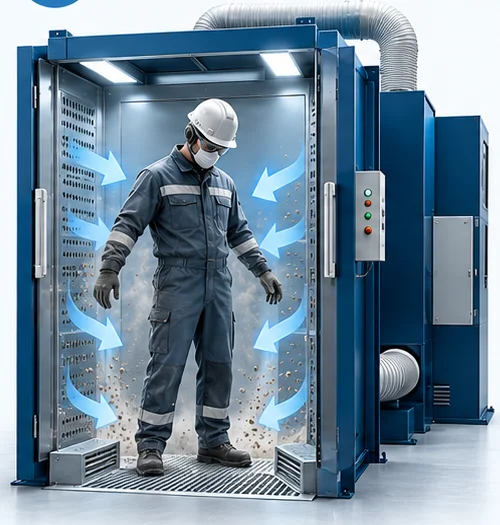
Controlled dust removal
- Organized workwear cleaning
- Dust extracted into the filtration system
- Less contaminant carry-over
Dust is not only removed but also extracted in a controlled way
Industrial dust: the invisible part of the problem
The hazard of industrial dust depends not only on its quantity, but also on particle size, chemical composition and properties. Coarse particles settle quickly, while fine ones stay suspended for a long time and are carried by air currents.
Particular attention is paid to respirable dust — particles that penetrate deep into the lungs when inhaled.
-
Mineral dust
Generated during mining, crushing and processing of mineral raw materials. It may contain respirable crystalline silica — long-term exposure is linked to occupational respiratory diseases.
-
Metal dust
Generated during metalworking, grinding and cutting. The hazard depends on the chemical composition, particle size and concentration.
-
Coal dust
Typical of coal mining, processing and transportation. It is linked to occupational lung diseases and, at certain concentrations, forms an explosive atmosphere.
-
Cement and construction dust
Generated in the production of cement and dry mixes, and in the processing and transportation of powdered materials. It settles on workwear, PPE and equipment and becomes airborne again.
Even with ventilation running, dust builds up on personnel’s workwear. That is why workwear dust removal is a separate element of the industrial hygiene system.
Compressed air, extraction and a dust removal booth: what’s the difference
Technical solutions against industrial dust perform different functions: they dislodge contaminants from surfaces, capture dust from the air, or combine both processes.
-
Compressed air blow-off
Dust is dislodged from the surface by the mechanical force of the jet — visible dirt is removed quickly.
Without dust collection, particles scatter around the room, and blowing off a person adds the risk of injury.
-
Exhaust ventilation
Removes contaminated air: general ventilation provides air exchange in the room, while local exhaust captures dust at the source.
It is an effective means of dust control, but extraction does not remove dust that has already settled on workwear.
-
Dust removal booth
Cleaning is organized so that dust is not only dislodged from clothing but also extracted: the exhaust system directs the contaminated air into the filter unit.
Airflows can be generated in different ways — including without compressed air.
The main difference is not in how dust is dislodged, but in whether its spread can be controlled after cleaning.
Comparison of dust removal methods
| Criterion | Open compressed air blow-off | Exhaust ventilation | Dust removal booth |
|---|---|---|---|
| Main purpose | Blowing dust particles off | Removing contaminated air | Comprehensive, safe workwear cleaning |
| Removing dust from clothing | Uncontrolled | Not provided without an additional mechanism | Controlled and effective |
| Capture of removed dust | None without additional equipment | Within the effective capture zone | Built into the design |
| Secondary dust spread | High risk | Depends on how airflows are organized | Low risk |
| Effect on people | Health risks for the worker | Depends on design and operating conditions | Controlled cleaning procedure |
| Contaminant filtration | Not provided | If a filtration system is fitted | Built into the design |
| Main application | Technical operations with safety measures in place | Control of contaminated air in the room | Cleaning personnel’s workwear |
The comparison is given for typical applications. Actual effectiveness and safety depend on the equipment design, dust characteristics and operating conditions.
Can extraction fully replace workwear dust removal?
Effective dust extraction and ventilation noticeably improve industrial dust control, but they do not prevent dust from settling on workwear. Personnel come into contact with contaminants when servicing equipment, moving between areas and during repairs — and even with organized air cleaning, some dust remains on workwear.
That is why it is important to distinguish between two tasks:
-
01
Airborne dust control
Prevents contaminants from spreading in the work environment.
-
02
Workwear cleaning
Removes contaminants that have already settled before the worker moves to other areas of the facility.
These tasks do not conflict; they complement the overall industrial safety system. A rational approach combines effective dust extraction, ventilation, safe work procedures and dedicated personnel cleaning.
What international guidelines and research say
Safe dust removal requires a systematic approach: it must take into account the effect on personnel, airflow patterns, contaminant capture and the properties of industrial dust. A selection of studies and guidelines is available in the “Case studies” section.
Why choose TITAN AIRLOCK
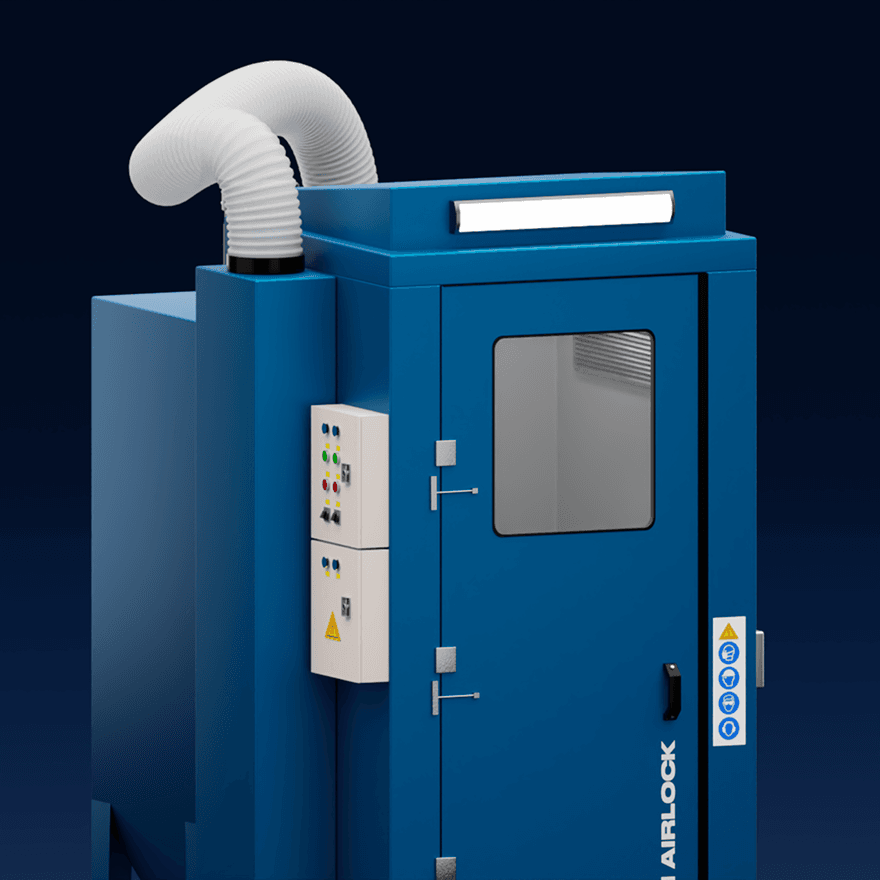
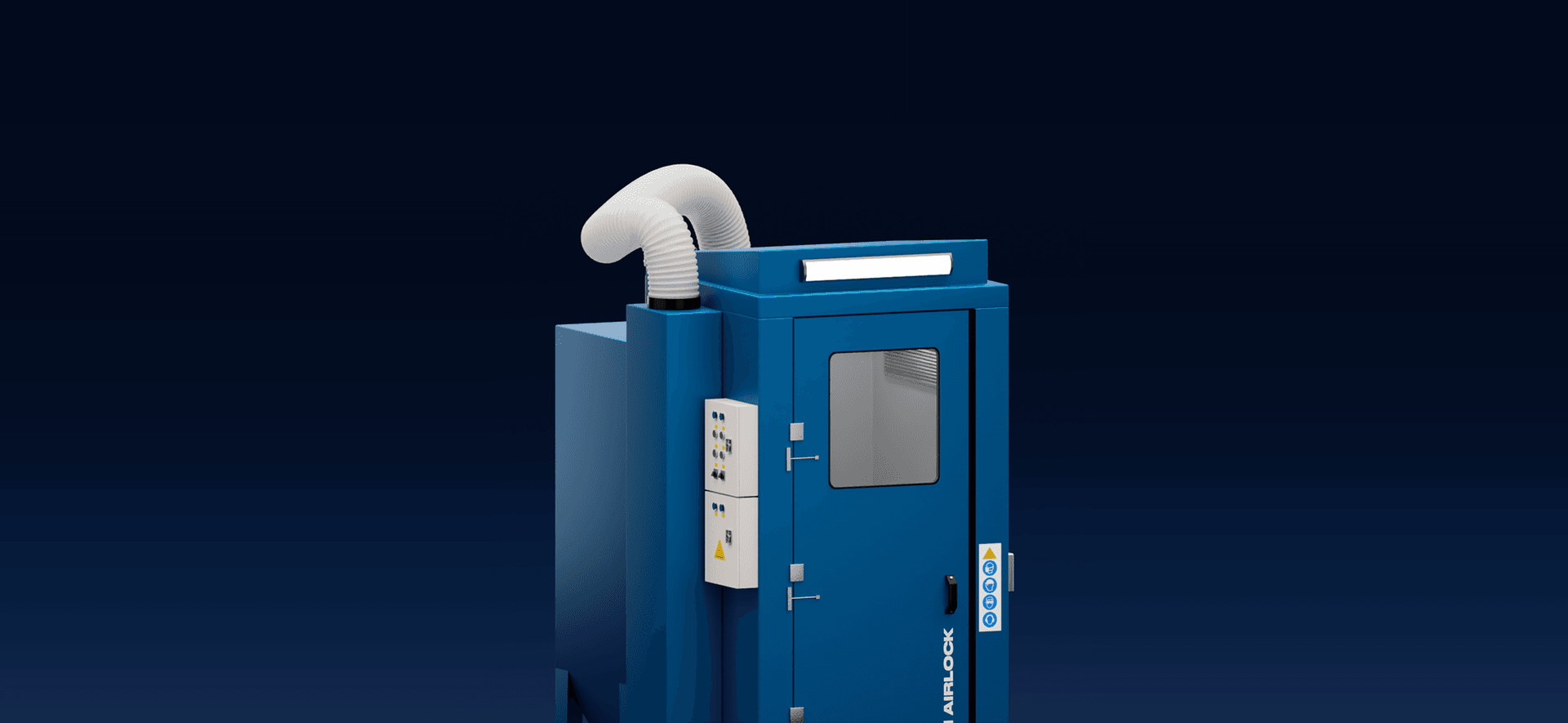
TITAN AIRLOCK is an engineering solution designed for real industrial operating conditions. The booth suits enterprises that need regular workwear cleaning and higher standards of industrial hygiene.
-
01
Versatile application
Suitable for mining, metallurgy, cement, chemical and other industries. Feasibility of implementation depends on operating conditions and the nature of contamination.
-
02
Integration into infrastructure
The booth fits into the existing industrial hygiene system without major changes to production processes. The installation site is chosen based on the layout and personnel routes.
-
03
Easy everyday operation
The equipment is designed for regular use. The organized cleaning cycle is easy to incorporate into daily production routines.
-
04
In-house manufacturing and engineering support
TITAN AIRLOCK is developed by TITAN Group. In-house manufacturing and engineering expertise allow us to support each project in line with the client’s technical requirements.
-
05
Long-term value
A dedicated dust removal system is an investment in production infrastructure, work organization and the safety culture of the enterprise.
Frequently asked questions
Open blow-off can injure a person and spreads dust particles around the room. Removing visible dirt from clothing does not mean the dust has been captured.
Lowering the pressure reduces some of the risks of mechanical impact, but does not solve the problem of secondary dust contamination. Without engineering controls, the removed dust still ends up in the surrounding environment.
No. Open blow-off directly on a person and purpose-designed systems with controlled air supply, protective measures and organized dust collection are fundamentally different things.
Ventilation handles contaminated air, but does not always remove the dust held in the fabric of workwear. That requires a separate process for dislodging contaminants.
It takes a set of measures: dust emission control at work areas, ventilation, properly organized sanitary transitions and workwear cleaning with subsequent capture of contaminants.
No. Dust removal systems are an additional engineering control. They do not replace mandatory personal protective equipment or other occupational safety measures.
A modern approach to industrial dust removal
Improving industrial safety requires moving from one-off cleaning operations to comprehensive management of industrial dust. Effective dust removal is not only surface cleaning, but also control over the further spread of particles.
The TITAN AIRLOCK dust removal booth, developed by TITAN Group, cleans workwear without compressed air and extracts contaminants into the filter unit. This reduces secondary dust contamination and dust carry-over between production areas.