



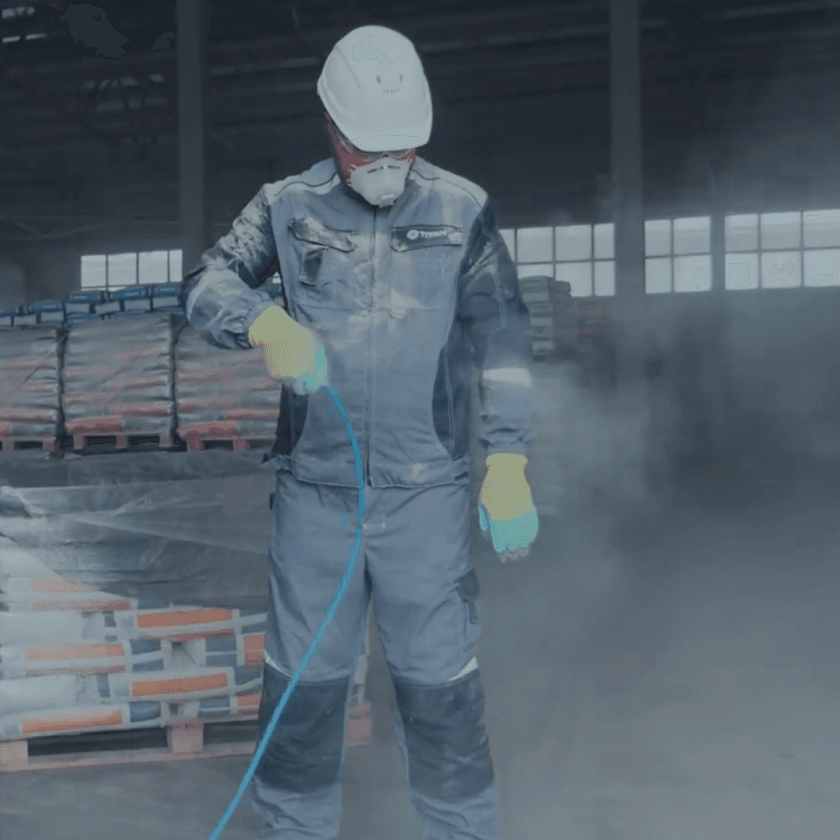


Why workwear cleaning at industrial facilities is not just a matter of hygiene, but a procedure required by sanitary regulations
The current sanitary rules “Sanitary and Epidemiological Requirements for Industrial Facilities”, approved by Order of the Minister of Health of the Republic of Kazakhstan No. KR DSM-13 dated February 11, 2022, set out specific requirements for the treatment of workers’ protective clothing.
Paragraph 120 contains a direct requirement:
“Dust removal and drying of protective clothing shall be carried out after each work shift.”
In other words, under the relevant conditions, workwear dust removal is not treated as an optional measure at the facility’s discretion, but as part of the set of treatment procedures prescribed by the sanitary rules. The sanitary rules effectively provide for periodic deep treatment and regular dust removal after each shift.
Dust removal after a work shift makes it possible to remove contaminants accumulated during work before the workwear is used again.
The sanitary rules “Sanitary and Epidemiological Requirements for Industrial Buildings and Structures”, approved by Order of the Minister of Health of the Republic of Kazakhstan No. KR DSM-72 dated August 3, 2021, provide for separate rooms for dust removal, decontamination, drying, washing and dry cleaning of workwear for a number of groups of production processes. Such rooms must also have a dedicated ventilation system.
The Department of Sanitary and Epidemiological Control clarifies that the set of sanitary and amenity rooms at industrial facilities is determined based on the nature of the production process and the presence of harmful factors; where necessary, separate rooms are provided for dust removal, decontamination, drying and treatment of protective clothing.
This shows that the handling of contaminated workwear is regarded as a distinct element in organizing the sanitary and amenity facilities of an industrial enterprise.
Why dust removal is always listed separately from washing
From a practical standpoint, this makes sense. At facilities with high dust loads, protective clothing gets contaminated during every work shift. At the same time, full washing or dry cleaning after every use can be difficult to organize and is not always covered by the established schedule.
This creates an intermediate task — removing accumulated industrial dust from clothing after work without waiting for the next deep treatment cycle. This is where dust removal becomes a production procedure in its own right.
The requirement exists. But how do you organize the process in practice?
The sanitary rules establish the need for dust removal but do not prescribe a specific equipment model or manufacturer. This leaves the facility with a practical question: how to organize the procedure so that employees can actually go through it after their shift quickly, consistently and without placing a significant additional burden on the work process?
If cleaning is done entirely by hand, its result and duration may depend on the employee. Large facilities face another challenge — throughput. If a large shift finishes work at the same time, the procedure must be fast enough that dust removal does not turn into a lengthy process for the entire workforce.
For an industrial facility, what matters is therefore not only that the procedure exists, but also:
- the duration of a single cycle;
- the ability to standardize cleaning;
- convenience for the worker;
- how the removed dust is collected;
- the ability to integrate the equipment into the facility’s sanitary and amenity infrastructure;
- throughput during shift changes.
This is the point at which a regulatory requirement becomes an engineering task.
How TITAN AIRLOCK can be used to organize dust removal
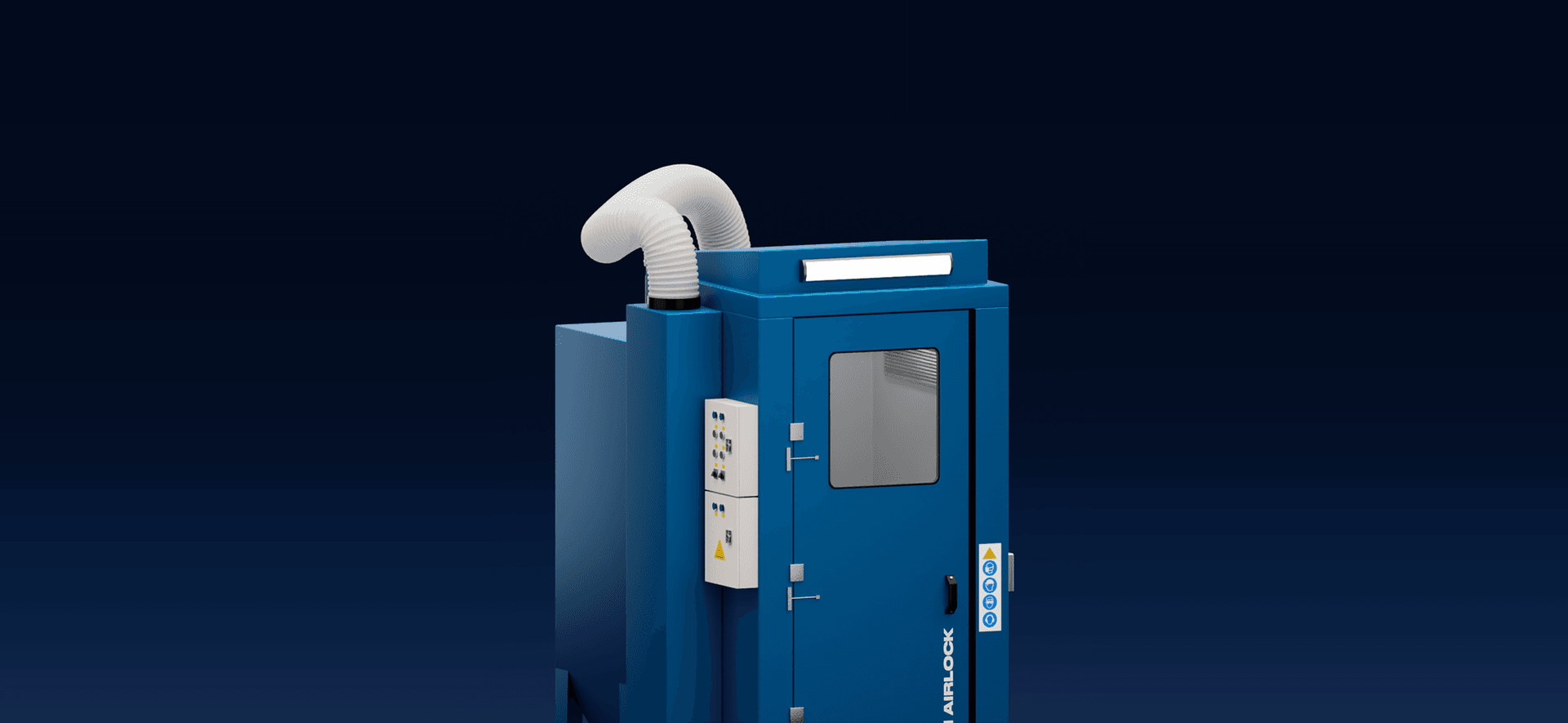
TITAN AIRLOCK is designed as a specialized booth for cleaning workwear directly at the industrial facility.
The employee enters the booth, starts the automatic cycle and has the dust removed without taking off their workwear. One cycle takes about 20–30 seconds. Particles removed from the clothing are directed to an external filtration system.
The system uses a high volume of air at low pressure. The design includes adjustable nozzles, and the removed dust is collected by the filtration system and dust collectors. For the stated configuration, the manufacturer specifies a captured dust filtration efficiency of more than 99.9%, depending on the composition and particle size of the contaminants.
For the facility, the key advantage of this approach is that dust removal can become a separate, standardized operation after the work shift, rather than being left entirely to the employee’s discretion.
The worker goes through the set cycle and can then proceed to further sanitary and amenity procedures.
The sanitary rules of the Republic of Kazakhstan set requirements for the treatment and dust removal of protective clothing and, for certain production processes, for the corresponding rooms. The choice of technical solution rests with the facility and must take specific production conditions into account.
In this case, TITAN AIRLOCK is an engineering means of organizing the required dust removal procedure: a short automatic cycle, an enclosed cleaning zone and collection of the removed dust make it possible to build the process into the facility’s daily operations. The characteristics and suitability of a particular configuration for a given site should be assessed individually.
Conclusion
In Kazakhstan, the need for dust removal from protective clothing is already enshrined in sanitary requirements. The question for an industrial facility is therefore how to organize this procedure effectively and systematically.
TITAN AIRLOCK offers one way to organize it: an automatic cycle lasting about 20–30 seconds makes it possible to carry out dust removal directly at the facility and direct the removed contaminants to a separate filtration system.
Here, the booth is not a substitute for sanitary requirements, but a technical tool for organizing the personnel dust removal procedure they prescribe.
Regulatory sources: Order of the Minister of Health of the Republic of Kazakhstan No. KR DSM-13 dated February 11, 2022 “On Approval of the Sanitary Rules ‘Sanitary and Epidemiological Requirements for Industrial Facilities’” and Order of the Minister of Health of the Republic of Kazakhstan No. KR DSM-72 dated August 3, 2021 “On Approval of the Sanitary Rules ‘Sanitary and Epidemiological Requirements for Industrial Buildings and Structures’”.