



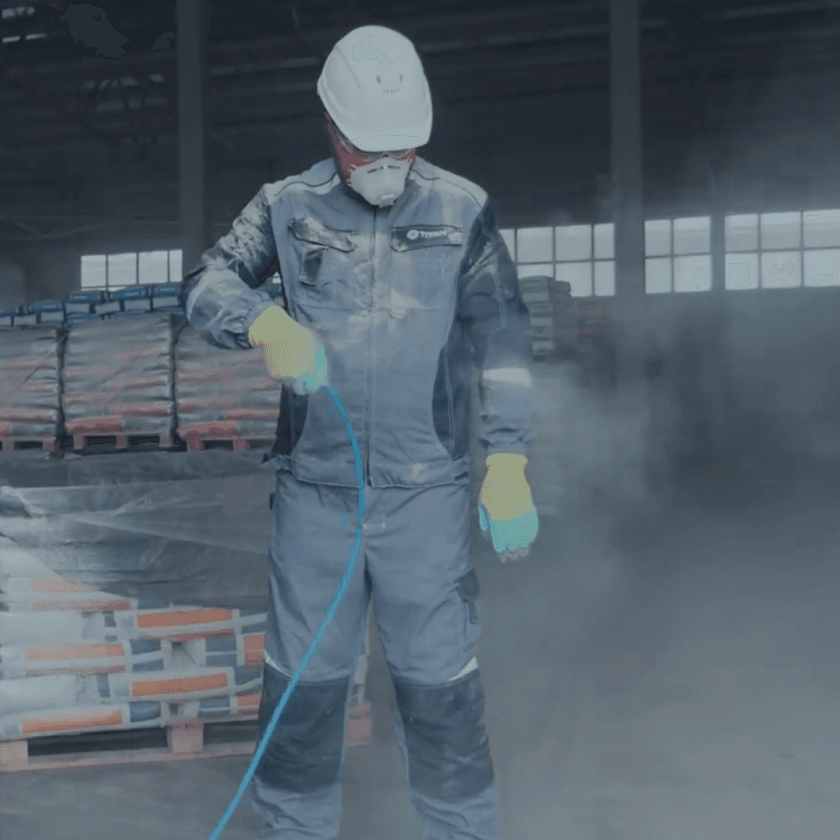


Industrial dust is a problem not only at the moment it is generated. A significant share of contaminants settles on workers’ clothing and stays there after production operations are finished. As the worker continues to move, the particles can become airborne again and spread beyond the contaminated area.
That is why one of the research areas of the U.S. National Institute for Occupational Safety and Health (NIOSH) has been the evaluation of systems designed to clean workwear directly on site.
The researchers set out to verify not only how well such a system removes contaminants from workwear, but also how well controlled the cleaning process itself remains.
How the study was conducted
The field tests ran for three days. Two people took part in the study, with 48 cleaning cycles performed for each of them. In total, the specialists carried out 96 tests.
Each cycle used workwear made of a polyester-cotton blend fabric. Before each test, the researchers artificially loaded the coveralls with dust to a level corresponding to heavy-duty working conditions. The clothing was carefully weighed before and after the procedure. This made it possible to determine the amount of dust applied and calculate how much of it was removed during cleaning. The researchers assessed three parameters at once: the cleaning efficiency for the clothing, the dust exposure of the user, and whether respirable particles could escape from the booth.
After analyzing all 96 cycles, the specialists found that the system under study removed on average 83.1% of the dust on the workwear. This is an important figure, because efficiency was not judged visually. The amount of contamination was measured by weighing the clothing before dust was applied, after loading, and after the cleaning procedure was completed.
In this way, the researchers were able to quantify the actual removal of contaminants from the surface of the workwear. One of the most important questions was whether the cleaning process itself might become a new source of contamination for the surrounding area.
During the tests, measuring instruments were placed inside the booth, in the user’s breathing zone, and at several control points outside it. After each cycle, measurements continued for another minute to detect any subsequent spread of particles.
Based on the results, the specialists found no evidence of respirable dust escaping through the monitored points around the booth during the tests. This shows that in a properly designed system it is important not only to separate contaminants from clothing, but also to contain them within the cleaning zone and then extract them from it.
Why this matters for an industrial facility
If an employee leaves the production area in contaminated workwear, the dust travels with them. It can end up in locker rooms, control rooms, break rooms, company vehicles and other areas where there is no longer any direct production source of dust. Workwear cleaning therefore becomes a separate element of the contamination control system, alongside dust extraction, ventilation and personal protective equipment.
The NIOSH tests show that a specialized enclosed system can address two tasks at once: removing a significant share of contaminants from workwear and controlling where the separated particles go next.
How this approach is implemented in TITAN AIRLOCK
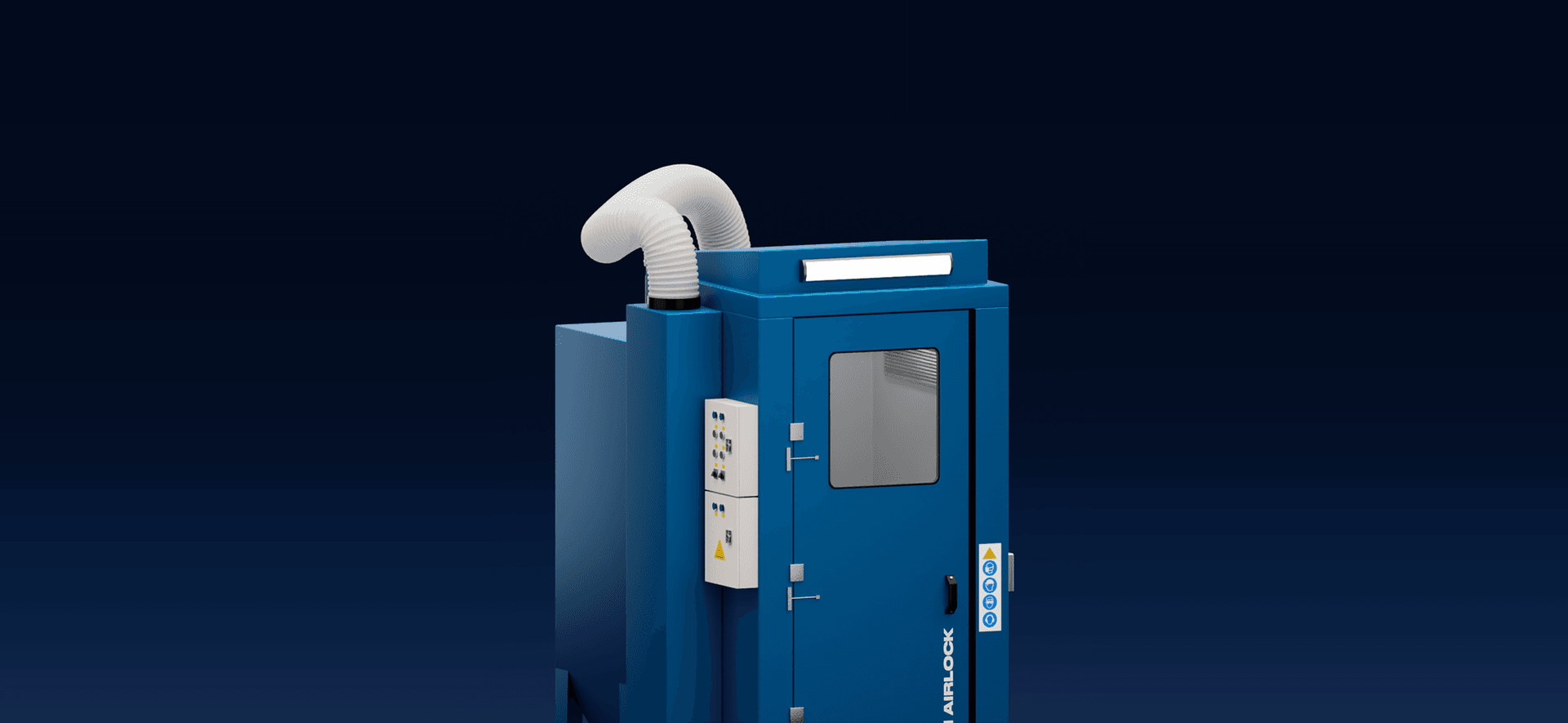
TITAN AIRLOCK is likewise designed to remove dust from employees right before they move from a contaminated production area into clean rooms.
Cleaning takes place inside an enclosed booth. The system generates a high-volume, low-pressure airflow that acts on the surface of the workwear. The removed contaminants are directed to an external filtration unit, where they are separated and collected. One TITAN AIRLOCK cycle takes about 20–30 seconds.
The design includes seven automatic blow-off channels, adjustable nozzles, downward airflow and a recirculation system. The booth’s rated capacity is 2100 m³/h, and the filtration unit provides a captured dust filtration efficiency of over 99.9%, depending on the composition and particle size distribution of the dust.
The NIOSH tests were not conducted on TITAN AIRLOCK, but they confirm the effectiveness of the engineering approach itself — cleaning workwear in a controlled enclosed system with organized removal of contaminants.
Conclusion
The results of 96 tests showed that an enclosed cleaning system can remove a significant share of dust from workwear. The average figure was 83.1%. At the same time, the measurements detected no escape of respirable dust through the control points around the booth during the tests.
For industrial facilities, this confirms the importance of a comprehensive approach: it is not enough simply to separate contaminants from the surface of clothing — you also need to control where that dust goes after it is removed.
This is exactly the principle behind TITAN AIRLOCK: workwear cleaning, containment of contaminants and their subsequent filtration within a single process.
Study source: National Institute for Occupational Safety and Health (NIOSH), Reducing dust exposure from contaminated work clothing using a clothes cleaning booth.