








What NIOSH research has shown, and why dust on workwear is not just a matter of cleanliness
At industrial facilities, dust control usually focuses on the source: crushing, material transfer, conveying, loading and other process operations. Dust extraction, ventilation, local dust suppression and personal protective equipment are used for this purpose.
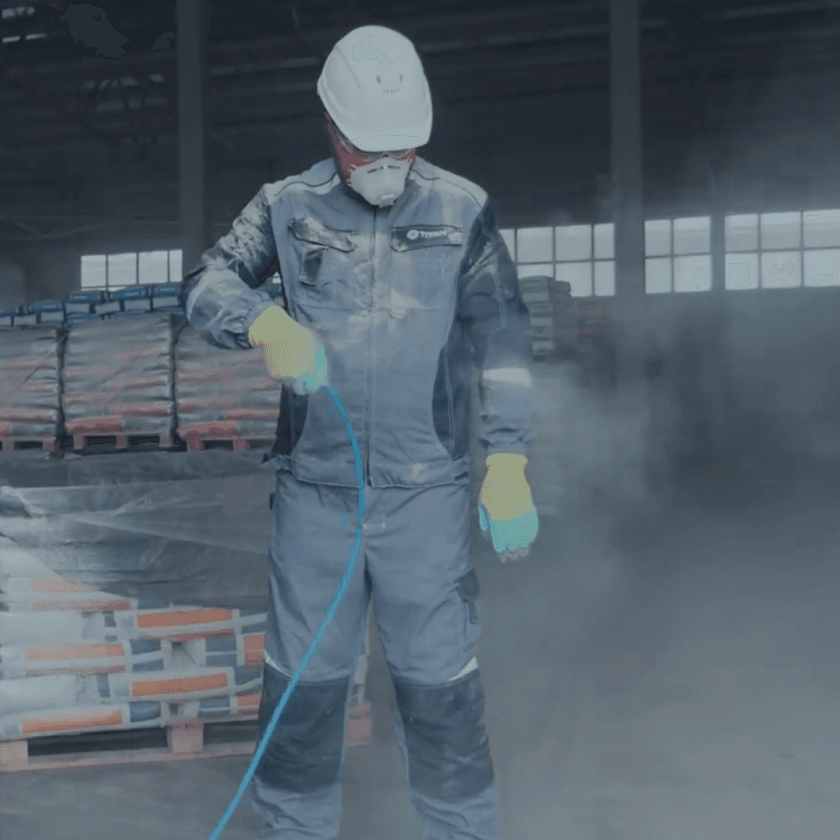
However, research has shown that even after dust concentrations in the work area itself have been reduced, another source of exposure remains — the employee’s own contaminated workwear. Particles that settle on the fabric during a shift do not stay put. When the worker walks, moves their arms and body, performs work tasks or takes off their clothing, some of the contaminants become airborne again and end up in the person’s breathing zone.
According to the U.S. National Institute for Occupational Safety and Health (NIOSH), in some of the cases studied, dusty workwear increased an employee’s respirable dust exposure by up to 10 times.
What exactly the researchers found
The problem was first documented in U.S. Bureau of Mines studies on dust exposure among workers at mineral processing plants. In two documented cases, the specialists established that contaminated clothing was the cause of a tenfold increase in workers’ respirable dust exposure. NIOSH later incorporated these data into its dust control recommendations for the mineral industry. And this is not only about visible coarse dust.
The researchers look specifically at the respirable fraction — particles fine enough to penetrate deep into the respiratory system. NIOSH notes that contaminated workwear can significantly increase exposure to precisely this kind of dust.
During work, contaminants gradually build up on the surface and within the structure of the fabric. Particularly large amounts of particles can be retained:
- in the folds of workwear;
- on the sleeves and shoulders;
- on the chest and back;
- on footwear;
- on protective gear.
Once settled, dust does not become safe. As the wearer moves, the fabric flexes, rubs against other surfaces and gets shaken. As a result, some of the particles detach again and enter the surrounding air.
NIOSH notes that in the cases studied, dust continued to be released from contaminated clothing while workers were simply performing their normal duties.
The result is a kind of secondary source of contamination: even if the employee has already moved away from the crusher, transfer point or other dust-generating equipment, some of the accumulated dust stays right next to them.
Exposure can persist even after the primary source has been eliminated.
This is one of the most important findings of the research.
A facility can significantly reduce dust levels in a work area using engineering controls, yet contaminated clothing can maintain a local concentration of particles right around the person.
Data published by NIOSH indicate that under the conditions studied, dust released from clothing could raise exposure to the point where a worker’s permissible limit could be exceeded in less than two hours.
That is why industrial dust control does not end with capturing dust at the process equipment. The entire contamination pathway must be taken into account: dust source → work area air → workwear → re-entrainment of dust.
If workwear remains contaminated after an operation or shift is completed, particles can be carried to places where there is no direct source of industrial dust. In practice, a similar problem can arise within a facility when an employee moves:
- from the production area to the locker room;
- to the control room;
- to the break room;
- to administrative and amenity areas;
- into company vehicles.
Cleaning workwear right before leaving the contaminated area therefore makes it possible to deal with the source of secondary dust spread before the employee moves on.
What TITAN AIRLOCK does in this case
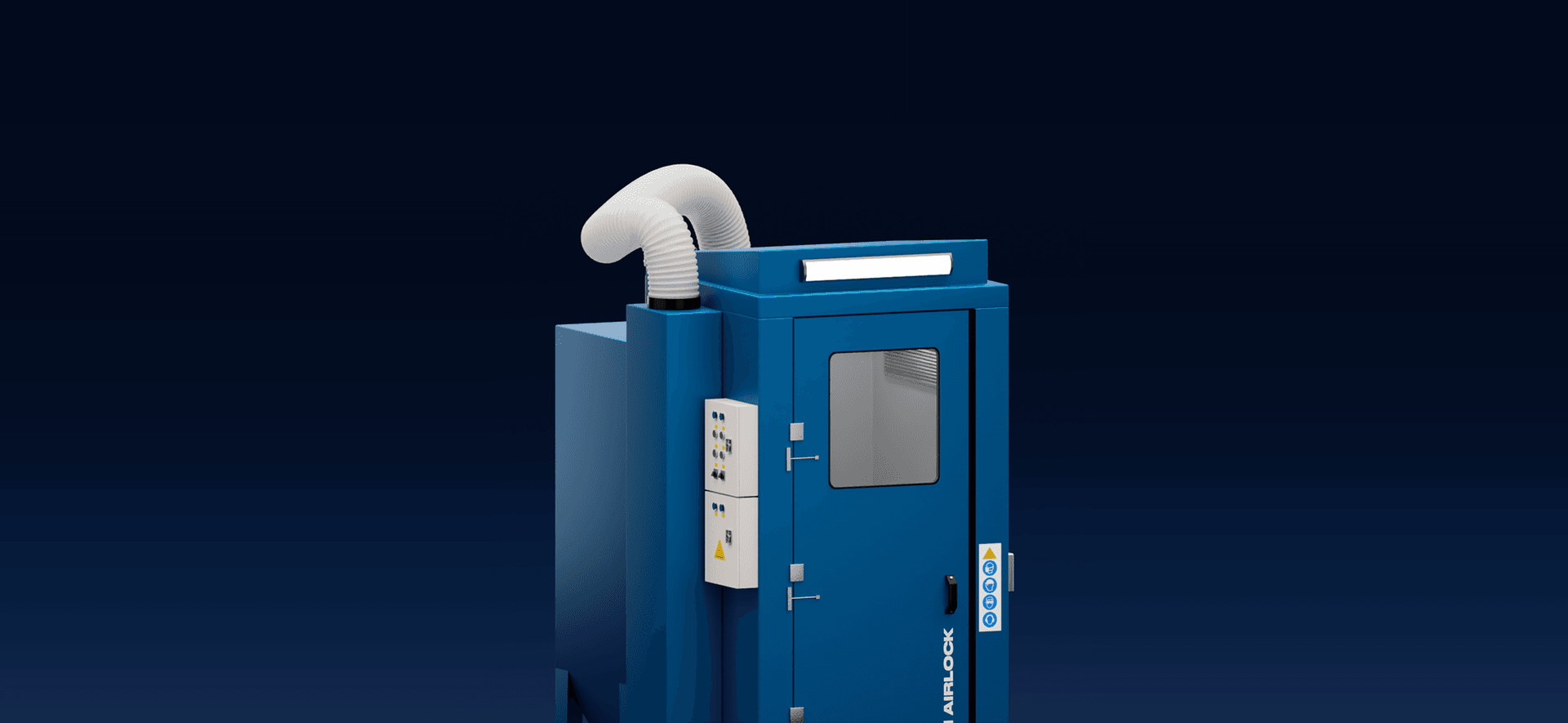
TITAN AIRLOCK is designed specifically to remove accumulated dust from workwear before the employee moves beyond the contaminated production area.
The worker enters the enclosed booth in workwear and goes through an automatic dust removal cycle. The airflow acts on different areas of the workwear, dislodging settled contaminants. The removed particles are then prevented from spreading freely around the employee: the contaminated air is directed to a separate filtration unit.
In other words, the booth targets exactly the source identified in the NIOSH research — dust accumulated on the workwear itself.
TITAN AIRLOCK does not replace dust extraction, ventilation, local dust suppression or personal protective equipment. It complements them by closing off a separate stage of contaminant spread between the production and clean areas.
What to understand about the study results
The “up to 10 times” figure does not mean that any contaminated workwear at any facility will necessarily increase exposure by exactly ten times. NIOSH refers to two specific cases documented by the U.S. Bureau of Mines at mineral processing plants. The actual level of secondary dust release depends on:
- the type and particle size of the dust;
- the concentration of contaminants;
- the clothing material;
- the duration of work;
- the nature of the employee’s movements;
- ventilation conditions;
- the dust protection measures in place.
Conclusion
Research by the U.S. Bureau of Mines and NIOSH has shown that dust settled on workwear can continue to be released into the air during an employee’s normal movements. In some documented cases, this led to a tenfold increase in respirable dust exposure.
This changes the very approach to removing dust from personnel. The goal is not only to reduce dust concentrations near production equipment, but also to prevent further spread of dust once particles have already settled on workwear.
TITAN AIRLOCK makes it possible to build workwear cleaning into the transition between a facility’s contaminated and clean areas, complementing existing engineering controls for industrial dust.
Sources: National Institute for Occupational Safety and Health (NIOSH) materials, including Best Practices for Dust Control in Metal/Nonmetal Mining — Clothes Cleaning Systems, and NIOSH Control Technology Research for Mining Hazards materials.